Speculation and a slower clock
Two savings, one source
My last post found that decode barely needs the GPU's full clock. It spends most of each step waiting on memory, so a slower clock costs little speed and saves a lot of energy.
Speculative decoding gets its savings from the same place. A small draft model guesses the next few tokens, and the big model checks them all in one pass. Checking several tokens costs about the same as generating one, because the cores were idle anyway. When the guesses are right, you get several tokens for the price of one step.
Both tricks spend the GPU's idle compute. So I wanted to know whether they add up, or whether speculation uses up the slack a slower clock would otherwise give back.
The setup
I served Qwen3-8B with vLLM on an H100 PCIe, a 350 W card with a maximum core clock of 1755 MHz. The draft model was EAGLE-3 (a published speculator for Qwen3-8B), guessing three tokens at a time. The prompts were real coding tasks and chat questions, since a draft model needs real text to guess well. It kept 43 to 50% of its guesses.
For each batch size from 1 to 128 requests in flight, I measured energy per token at the default clock and at six locked clocks from 1755 MHz down to 705 MHz, with speculation off and then on. Energy came from the GPU's own counter. The code and raw data are on GitHub, and the whole run cost under $3 of GPU time.
Stacking, then competing
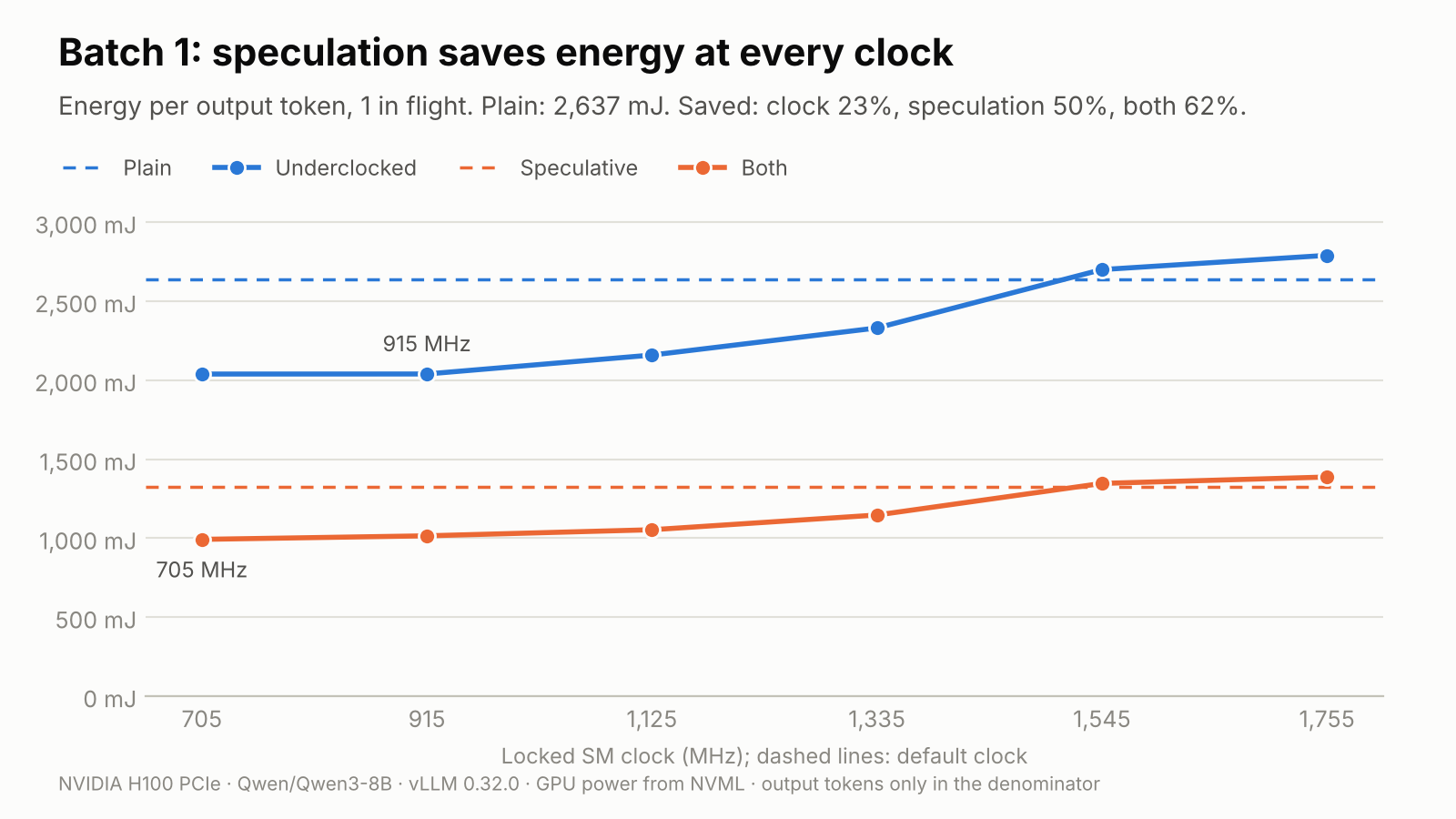
With one request in flight, the best locked clock alone saves 23% of the energy per token. Speculation alone saves 50%. Together they save 62%, and the GPU still decodes 1.65 times faster than it does with neither.
The right comparison isn't the sum, 73%. Two independent savings compound: if speculation leaves half the energy, a 23% clock saving applies to that half. That predicts 61%, and the measured 62% matches it. Up to 16 requests in flight, the two savings stack like that.
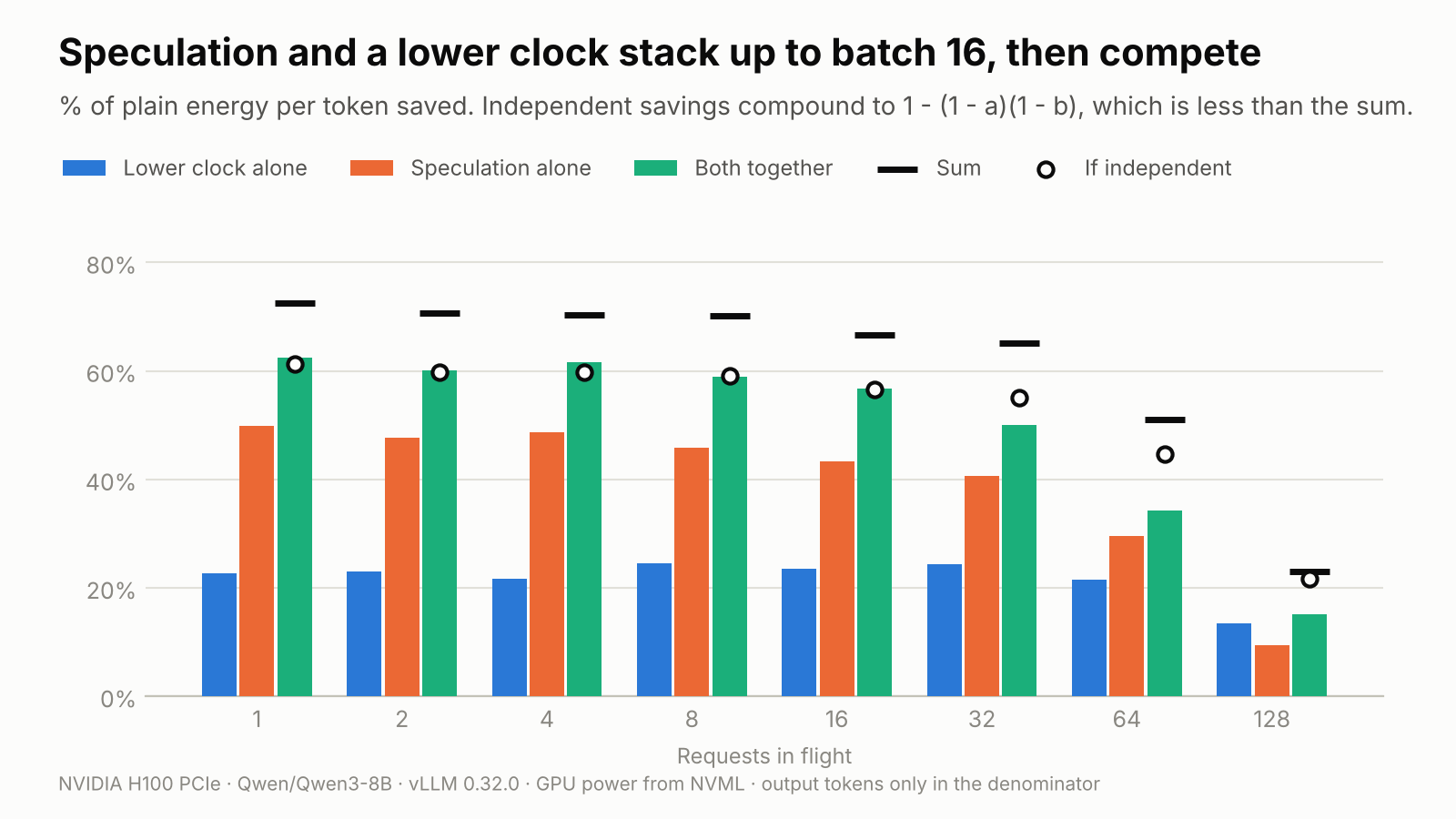
Past 16, they start to compete. At 32 requests in flight, independent savings would give 55% and the pair delivers 50%. At 64, 45% predicted and 34% measured. At 128, speculation alone saves only 9%, and the pair saves 15%, barely more than the clock's 13%.
Why they collide
At small batches the GPU is mostly waiting on memory, so there is idle compute for speculation to use and idle time for a slower clock to reclaim. The two barely overlap.
At large batches the idle compute is gone. Every verification pass now does real work for 128 requests, and the extra guessed tokens compete with real ones for the same cores. Speculation has less to give, and so does the clock, because a busier GPU needs its cycles.
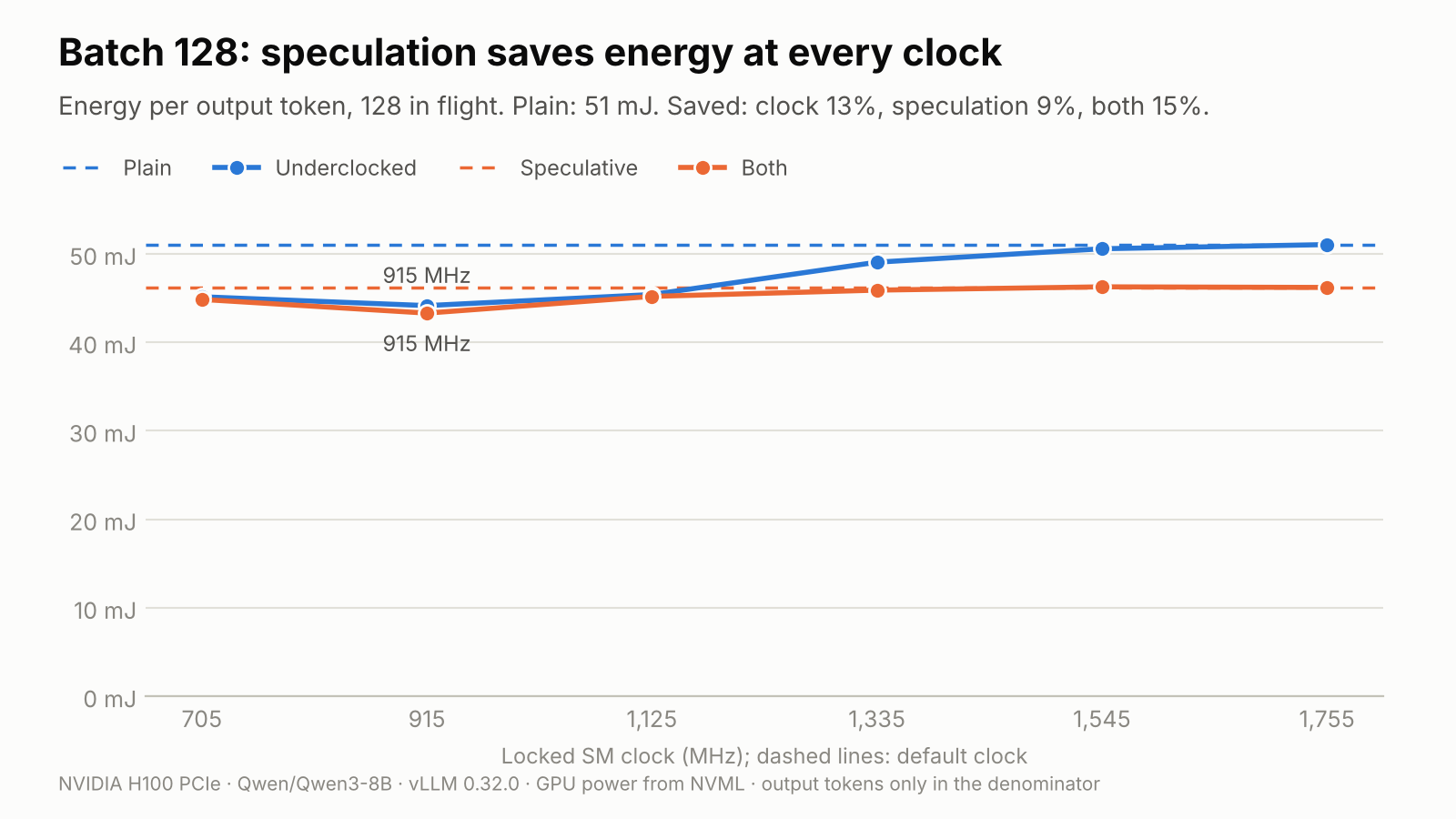
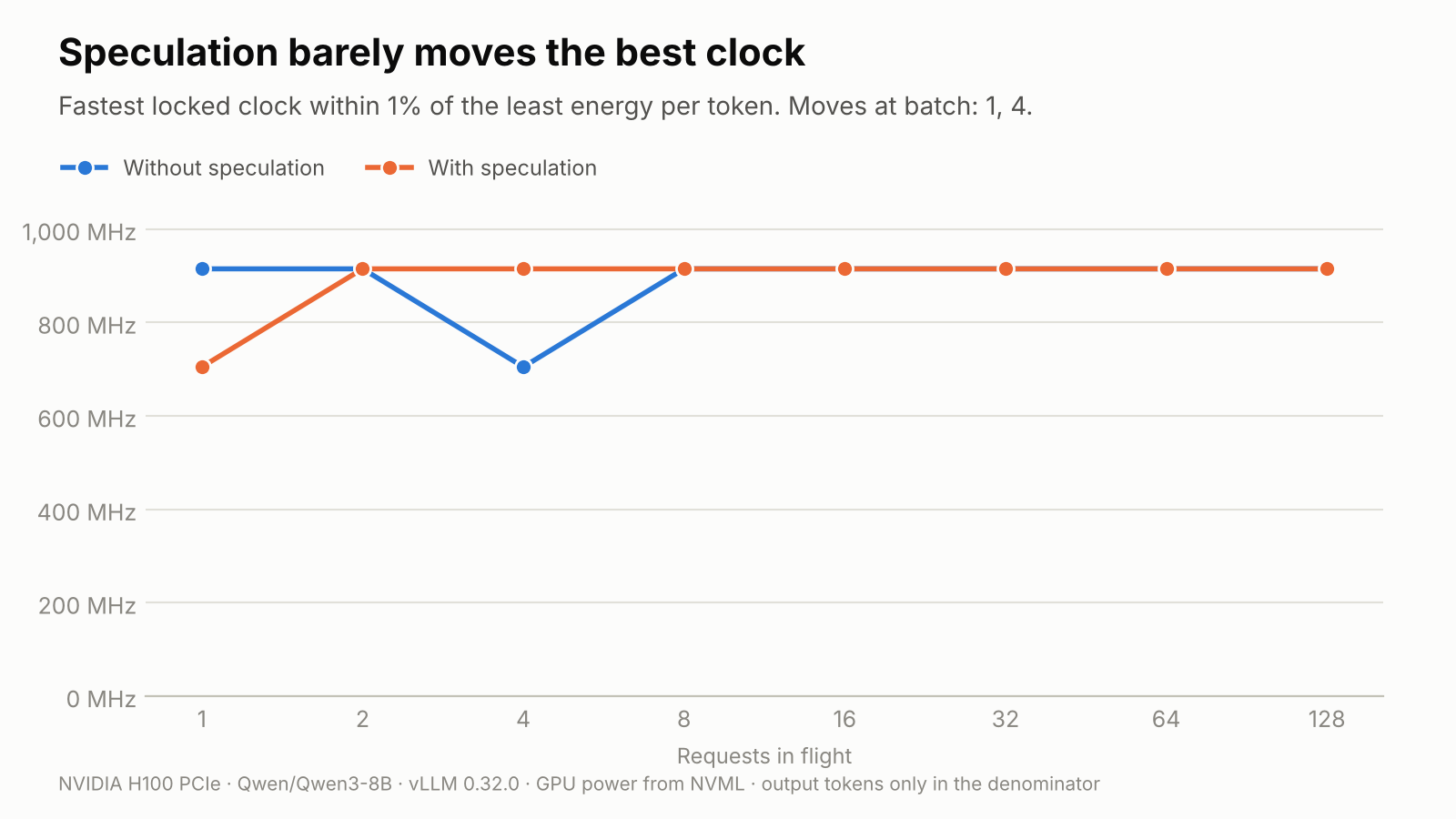
I expected the best clock to rise with speculation on, since speculation makes decode do more math per byte. It mostly didn't. Energy per token bottomed out around 915 MHz with or without the draft model, at nearly every batch size. Below that, decode slowed as fast as power fell, so the savings stopped.
One card is a narrow test. This PCIe card already runs near its 350 W limit at large batches, which caps what a lower clock can save there. A 700 W SXM card may do better.
What it means
Use both, but know where the second one stops paying. At the small batches typical of latency-sensitive serving, speculation and a locked clock of about half the maximum together cut energy per token by around 60% and still make decode faster. At large batches, pick one. The clock is the safer bet, since it never depends on how well the draft guesses.
Neither needs new hardware. One is a config flag and the other is a single nvidia-smi command.